

We were one loose carpet tile away from visiting Turkey. Our flight from Miami to Sorrento was delayed because of a loose piece of carpet towards the back of the plane. FAA regulations require even minor in-cabin repairs to be documented and signed off by the airline’s maintenance control. For us, that meant waiting three hours for paperwork approval from their office in Colorado. A three-hour delay was actually a blessing, though, because we had a two-hour layover in Istanbul. So we eventually boarded, sat on the runway for 40 minutes, and bid Miami an “Hasta la vista, baby!”
I’d recommend a red-eye flight when flying to Europe. They’ve got electrochromic windows that slowly shift to a red tint before eventually turning black, which helps set our circadian rhythm and prepare our bodies for sleep. We set our phones to Istanbul time before we left. Our flight took off around 4-5pm Miami time, and by 7pm, it was pitch black. If you’ve never tried sleeping overnight on a plane, I highly recommend it (LINK). There’s nothing worse than the sleepy head flop every 10 minutes during your 11-hour flight. The neck pain too—stick a knife in me. Anyway, this nifty invention is like wearing an eye mask and duct-taping your head to the seat so you don’t headbutt your neighbor.
As a welcome gift for flying on the number one airline in the world, Turkish Airlines gives you an amenity kit with a sleeping mask, socks, ear plugs, toothbrush, toothpaste, chapstick, lotion, and—get this—SLIPPERS. Everyone was walking around in these red slippers like we were part of a cult.
When you’re on a long international flight, a good night’s sleep is crucial if you have anything planned for your first travel day. I did a bit of research on how to sleep well on flights, and I’ll share the best tips I found:
- First, fly red-eye if you can. It’ll help set your circadian rhythm, making it easier to adjust to the local time. You’ll land ready for the day ahead. Invest in a solid sleep mask (LINK).
- Second, set your watch to your arrival time. During the flight, you’ll probably sleep on and off—turbulence, meals, and neighbors can all wake you. A quick glance at your watch or phone can help you decide if you should be waking up or trying to sleep a little longer.
- Third, compression socks (LINK) are a game-changer for leg discomfort during long flights. Aim for a pressure of 15-20 mmHg, which is generally recommended for travel. If your doctor has prescribed a higher pressure, go with that.
- Fourth, find something boring to do that will put you to sleep. For me, it was trying to read The Art of War, a book about military strategy that I can barely wrap my head around. It’s perfect for putting me to sleep.
In the morning, we had a bit of turbulence as we neared our destination. One of my favorite things to do during turbulence is sit up straight and watch everyone around me. Every bump causes all 300 heads in front of you to move the same way. It’s like synchronized swimming.
It’s always interesting to observe the passengers on the plane. There were a bunch of families, but also several 20–30-year-old men traveling solo. A few had hats on, and my neighbor had his hoodie up. At the time, I had no idea what was going on, but I would soon be surprised. Once we landed, we used the spotty airport Wi-Fi to plan how to spend our 13-hour layover and learned that Istanbul Airport had been rated the best in the world. Naturally, we were excited to see what all the hype was about. We deboarded and quickly learned that the airport rating agency doesn’t prioritize air conditioning.
I also quickly learned something important about air conditioning: it’s not just about temperature control—it’s about humidity control. The airport was muggy, and it hit me immediately. But hey, the airport was beautiful. Contemporary design: high ceilings, sweeping glass walls, and an airy layout. All the room was great because we had a tour to catch. Turkish Airlines offers a completely FREE tour of Istanbul if you have a layover that is between 6-24 hours. We got off the plane around 7 am and had absolutely no idea where the booth for TourIstanbul was, so we waited in a customer service line behind one person which took 15 minutes. Ok. Turns out that was the wrong line. So, we eyed the correct line and there were about 15 people in it and two agents. Great.

We waited in line, our customer service agent didn’t speak much English, after a minute of blank expressions on all of our faces. I showed him them the logo of the company and said TourIstanbul? Ding ding ding. Winner. That was the correct thing to say, his eyes lit up. He pointed to the glass door to exit the terminal and give us instructions which we didn’t understand. With wide eyes we shook our head yes and walked through the door to leave the terminal, having no idea whether or not we could re-enter. We might have just illegally entered the country, no idea, just following instructions here.
Once we passed through the doors of no return, we were stopped by a security guard asking us something in Turkish. He asked for our passports, mine, which was completely empty. He said in English “American, why you come to Istanbul?” and pointed to my empty passport. We were on a mission so I said “TourIstanbul” and asked if he could direct us. He said that they close registration at 8 AM and it was a 20-minute walk from here. We asked if he could call and he said in broken English, “No call, you won’t make it.” I looked at the clock, 7:50 AM.
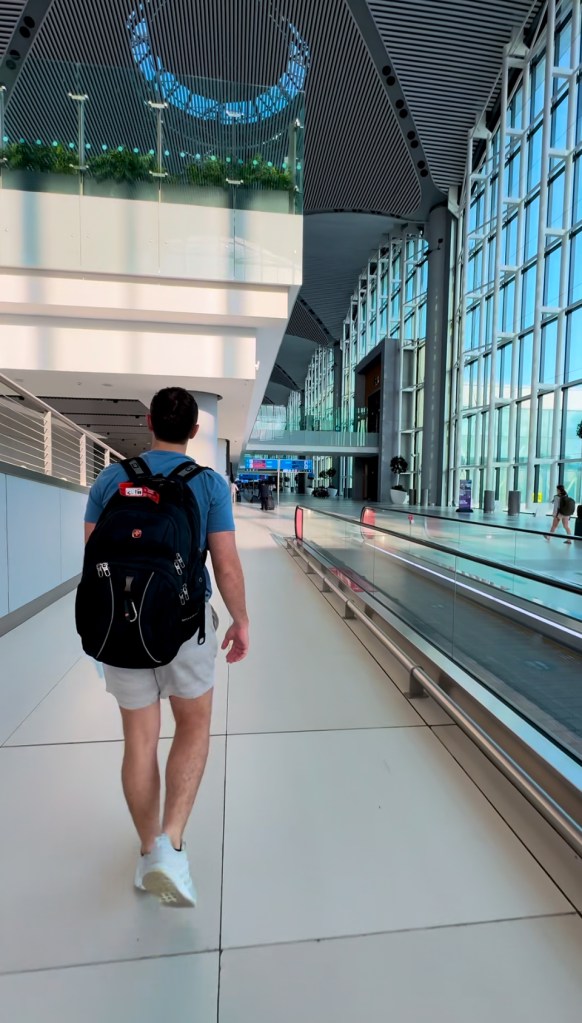
Now I’m not one to share my insecurities, but one of them is running with a backpack on. There’s just some deep ingrained trauma there for some reason. But, when there’s a free tour on the line and you’re in an airport surrounded by people you don’t know, speaking a language you can’t understand: you’re free from judgement. So we ran. Sprinted.
So we took off running, backpacks on and everything. Along the way we had to ask for directions, which looked like this. Two Americans in PJs, running through an empty airport at 7:30 am approaching the airport transport staff showing them a logo and saying “TourIstanbul? ”. I think I even threw a Spanish “donde es?” in there every once in a while. When someone is speaking a language that I don’t know I sometimes try to speak Spanish for whatever reason. I did this in Italy too. Whatever. I don’t know.
Anyways at this point in the story we are still sprinting down the hallways. We got through customs in less than a minute and there we saw it on an airport sign. The IstanbulTours and an arrow pointing down a very long hallway. It was 7:59AM. We sprinted down the hall, the other tour guides lining the halls looking at us in awe and shouting prices at us. The very last booth on the right was our guide. There was nobody standing outside the area, no line and it had just turned 8:00AM. We blurted something out along the lines of “We’re here” like they were expecting us. She said the tour is closed for the day. We asked if there was anything she could do. She said let me see if there’s anything I can do. Because I was leaning on the counter, I could see over it just enough to see her keyboard. She turned to her coworker, said something in Turkish, and then hit the Spacebar button a few more times for good measure. She said, “nothing I can do, tour closed.” Devastation.
We dreaded the idea of spend our 10+ hour layover sitting in the airport with no air conditioning and a free 30 minute wifi trial. We also dreaded the idea of doing the walk of shame past all the tour guides that were hounding us on our walk down. There’s probably 15-20 tour guide booths down the hallway. We agreed to ignore them and walk back towards security.
Fast forward five minutes. We were booking a tour. I caved easily. When someone says “Cheapy cheap” you’re doing yourself a disservice to not ask how much. I admit the guy knew what he was doing. $120 for a 90-minute round trip drive to the airport and a tour guide that speaks English? Doesn’t get better than that. Except our tour guide didn’t speak a word of English.
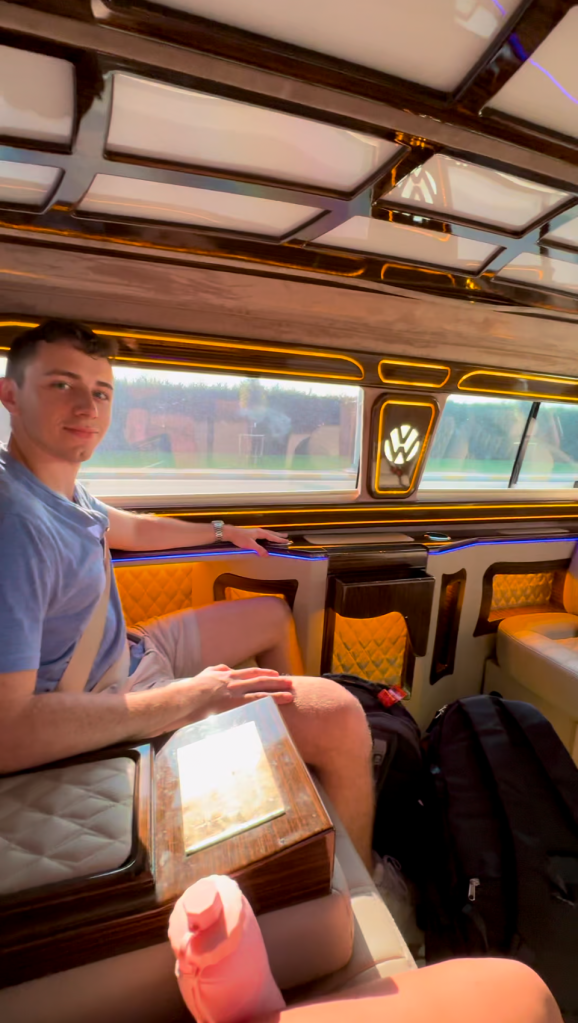
Our tour guide was a nice 20-year-old man who came up to us with a phone and translator app. This was our van set-up. We drove through the winding roads in the country-side. The countryside was beautiful. There were rolling green and golden hills, cypress and olive trees. Once we started to approach the city, the rolling hills became homes. And there were homes everywhere. We went up a steep hill in the city and you could see for miles. In every direction there were houses as far as you could see. They were all a several stories tall and built almost on top of one another.
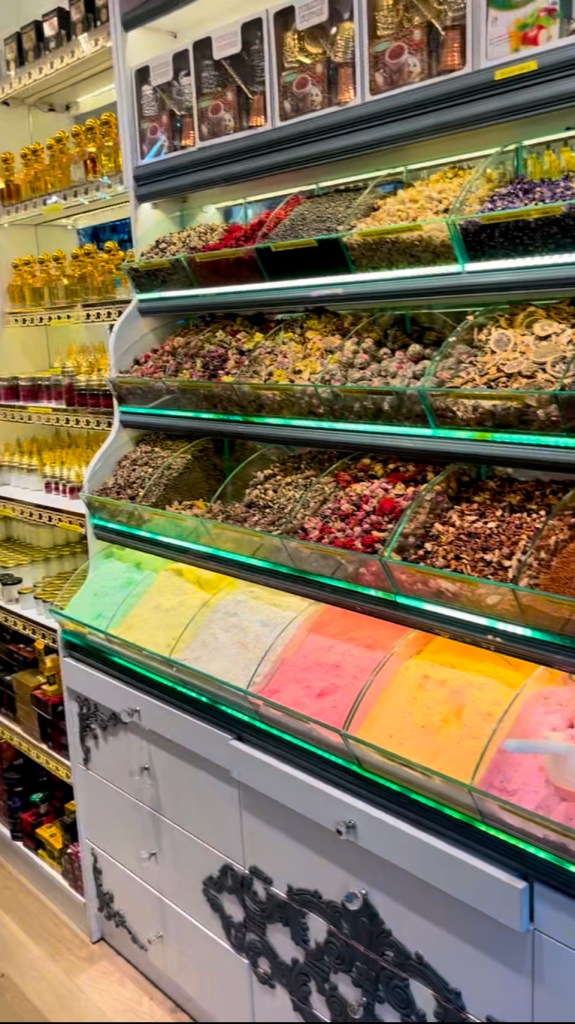
Our first destination was the Bazaar Abdülhamid, which was essentially a big Turkish candy store. It was one of those places that just pulled you in. The colors lining the walls, the smell of roasted nuts, honey, and spices hit us like a warm hug. Shelves were stacked with jars of saffron, dried fruits, and enough Turkish delight to make you question how much sugar your body could handle in one sitting. The shopkeeper, an older guy with a huge smile, immediately started handing us samples and tried to sell us a hijab.
The place wasn’t just about sweets, though. They had walls lined with raw ingredients—loose-leaf teas, hand-ground spices, dried figs—basically, everything you’d need to recreate Istanbul’s flavors in your own kitchen.
In the back there was a wooden staircase tucked in the back, leading up to a carpet shop. Upstairs, the air smelled like aged wool and history. Carpets covered every inch of the walls, deep reds and golds woven into intricate patterns. One of the guys up there started explaining the differences in materials and weaving styles. The whole place had this old-world charm, like you’d accidentally stepped into a time capsule of Turkish craftsmanship.
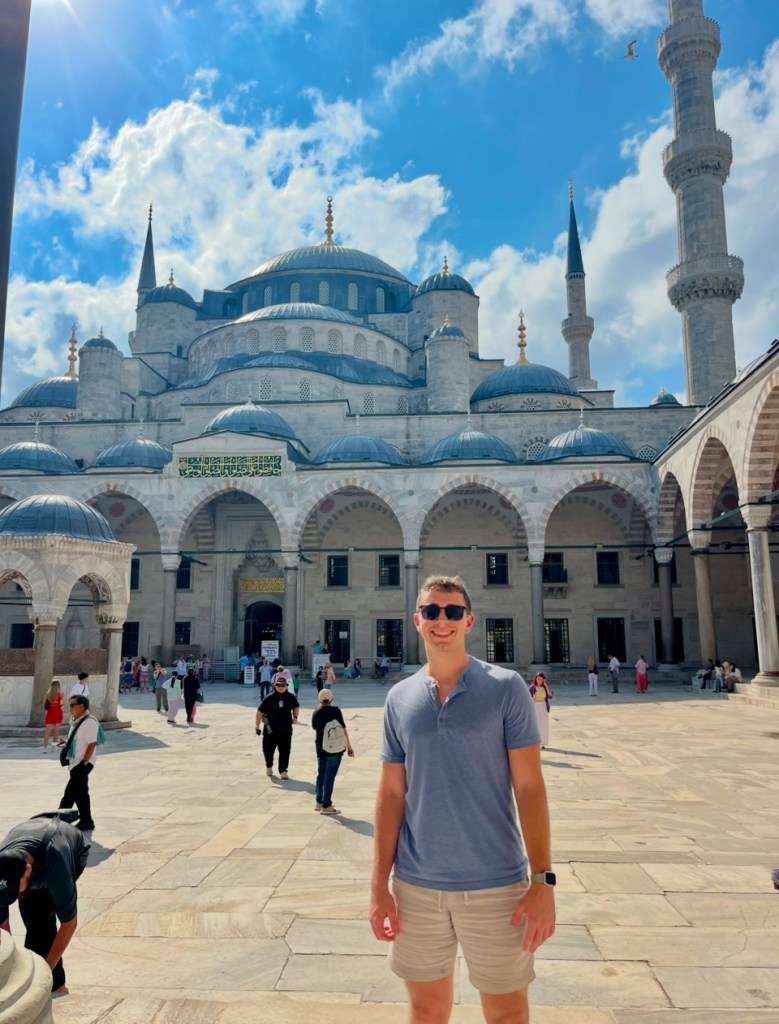
Next we met with our second tour guide of the day, an 18 year old student saving up money to go into dentistry. He walked us to the Blue Mosque. The sheer size of it was insane—towering minarets, massive domes, and the kind of intricate tilework that makes you wonder how much patience people had back in the day. The inside was even more impressive. Soft light filtered through stained glass windows, casting colorful patterns on the deep blue tiles that stretched from floor to ceiling. The calligraphy, the chandeliers hanging low, the sheer silence despite the number of people—it all made the place feel almost unreal.
The Blue Mosque was built in the early 1600s by Sultan Ahmed I, and it’s basically his way of flexing on the world. The goal? Make something even more impressive than Hagia Sophia. And honestly, he got close. The inside is covered in over 20,000 handmade blue Iznik tiles, giving it that signature glow. It’s still an active mosque, so while tourists are snapping pics, locals are praying. Also, fun fact—most mosques have four or fewer minarets, but this one has six, which caused a bit of drama back in the day because only Mecca’s Grand Mosque had that many. Minarets are the little towers around the Mosques.
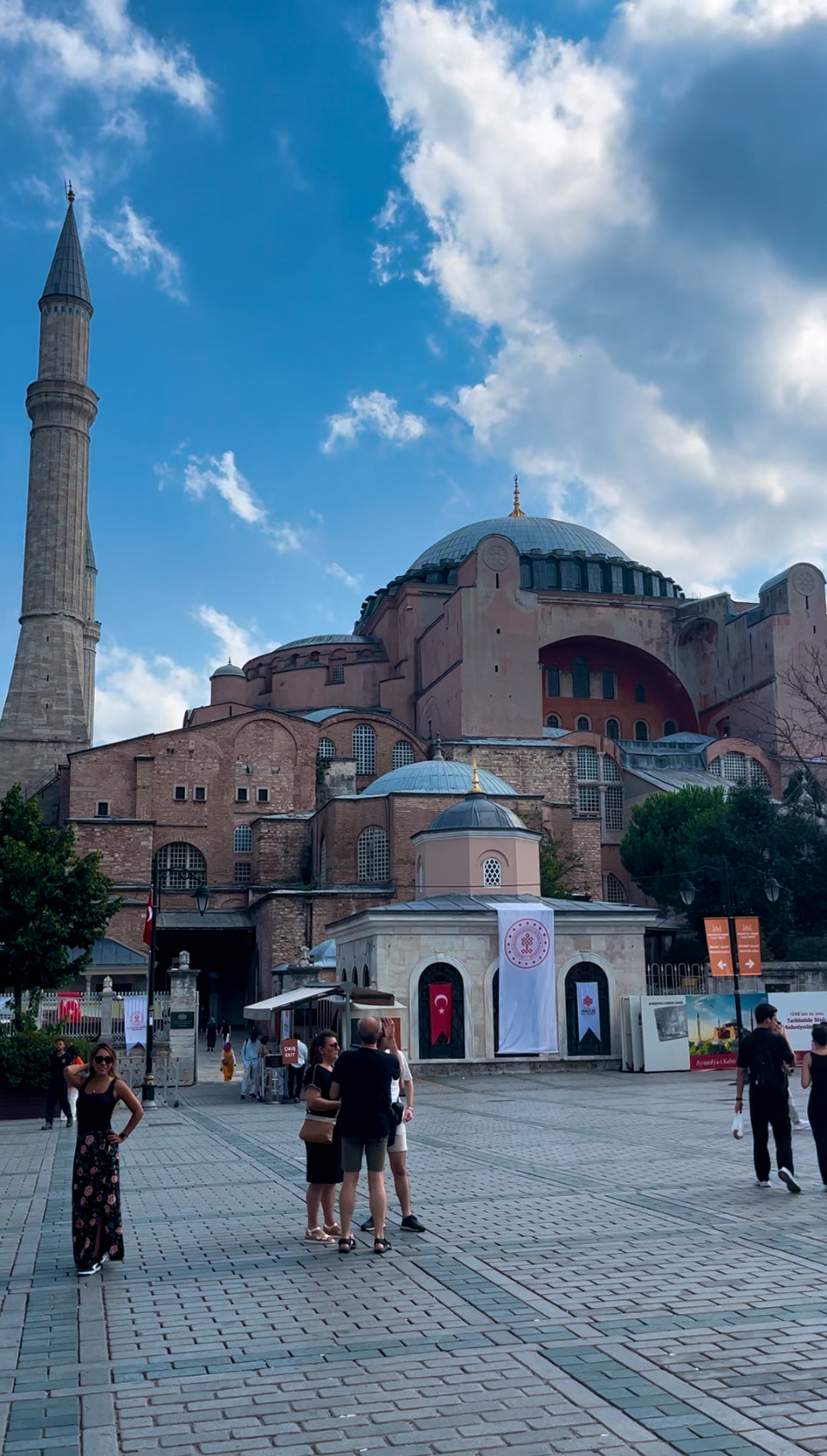
We took our time, snapped some photos, and just soaked it all in. It’s one of those places that actually lives up to the hype. After that, we made our way to Hagia Sophia, just a short walk away. The moment we stepped inside, it hit differently. Where the Blue Mosque felt serene, Hagia Sophia felt ancient and powerful. The mix of Islamic and Christian elements was wild to see in person, like stepping into a living, breathing history book.
The Hagia Sophia started as a Byzantine church in 537 AD under Emperor Justinian I and was the biggest cathedral in the world for almost 1,000 years. Then the Ottomans rolled in, turned it into a mosque in 1453, and added minarets. In 1935, Turkey made it a museum, but in 2020, it became a mosque again. Inside, you’ll see a mix of Christian mosaics and giant Arabic calligraphy, like two different worlds colliding in one building. It’s easily one of the most mind-blowing places in Istanbul.
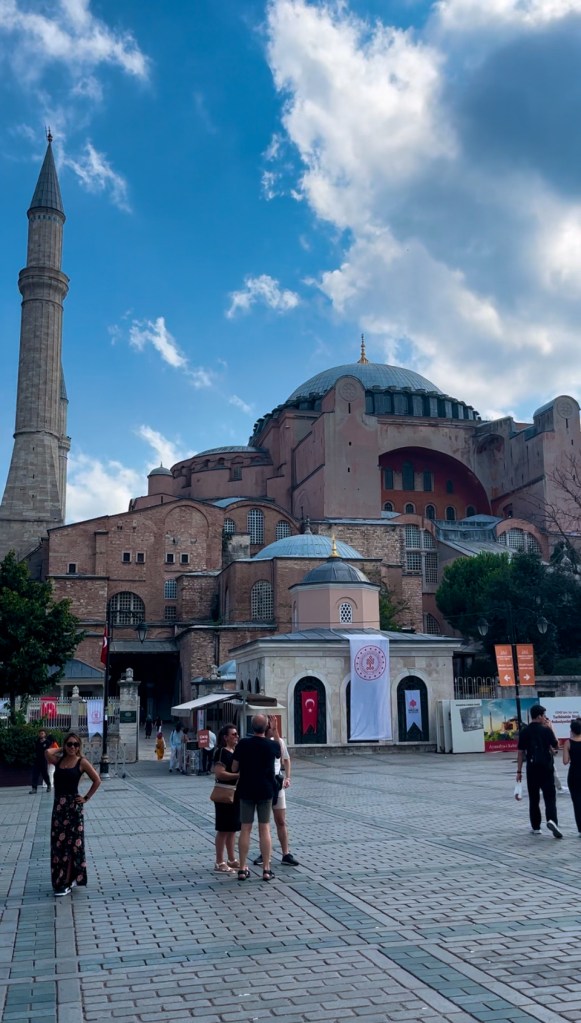
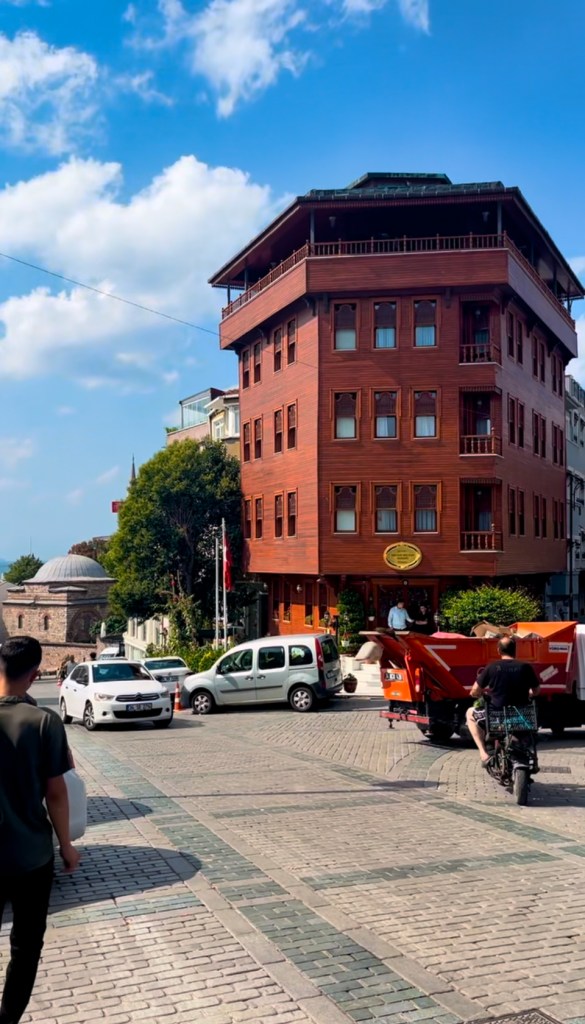
Then we walked back toward our candy shop, passing by buildings that looked like they belonged in a history book. The area around the mosques has this old-world vibe—arched doorways, carved stone details, and little balconies that look like they’ve been there forever. Some places were restored and looked brand new, while others had that perfect mix of worn-down and still standing strong.
Back at the shop, we tried more samples. Everything was so good, words don’t do it justice. If you ever go to Turkey and don’t try a Turkish delight, you’re doing it wrong. If we had local currency, we would’ve walked out with a bag full of them, no question.
Upstairs, we met the owner of the carpet shop above. He was from Istanbul but had played soccer on scholarship in the U.S. Funny enough, he went to school about 40 minutes from my hometown, Kansas City. After graduating, he moved to Florida and worked there until just after 9/11. He said after the attacks, because of his religion and where he was from, the government revoked his work visa, forcing him to return home.
He was sharp—one of those people you instantly recognize as someone who’s seen a lot, thought a lot, and figured out a thing or two. He gave some solid advice: travel while you can and soak it all in. Opportunities are out there, but you have to put in the effort to find them. He told us he was happiest when he was traveling, but in the end, being close to family is what matters.
He said Istanbul was grindy. The culture is completely different from the U.S. In America, it’s easier to be successful. Here, you’re always treading water, doing what you have to do to survive—including shady business tactics, like taking advantage of tourists. He owned and designed carpets now, but his business was limited because he refused to sell online. If he did, China would steal his designs, mass-produce them for cheaper, and put him out of business. His family depended on his work, and his designs were his legacy—he had to protect them.
And the crazy part? He wasn’t trying to sell us anything. He just took time out of his day to share some wisdom with two young, eager-eyed kids who wanted to learn.
Before we left the candy shop, our tour guide gave us a taste of something I wasn’t expecting—a fruity alcoholic drink, the Turkish national drink, Rakı. It had a sweet, licorice flavor that caught me off guard in the best way. A perfect send-off before we headed out for our short trip to the city.
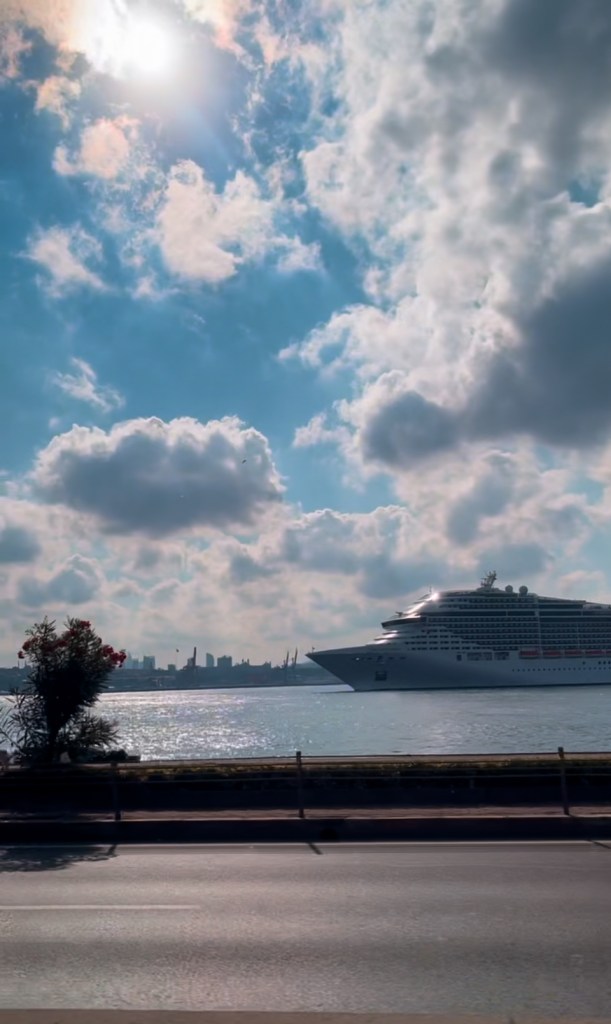
Next our tour guide drove us downtown along the Bosphorus Strait. The Strait was full of massive cargo ships, cruise liners, and smaller passenger ferries weaving between them. The water was so blue it almost didn’t look real. This was the stretch of water that literally separates Europe from Asia—the Bosphorus Strait. Just standing there, looking at the water, it hits you—you’re between two continents. The link between the Black Sea and the Sea of Marmara, which leads to the Mediterranean. It makes sense why Istanbul was such a strategic stronghold for centuries. Controlling this city meant controlling trade routes between Europe, Asia, and beyond. That’s why empires fought so hard for it—the Byzantines, the Ottomans, countless others. Trade, power, and religion all collided here, shaping history in a way that few other cities ever have.
We crossed the bridge and stepped into the continent of Asia. The bottom level of the bridge was lined with seafood restaurants, open-air spots where you could smell the sea air and watch the fishermen working their way up and down. It felt like walking through a scene in an old film, with fish flying past me as they were reeled in from both levels. Once across, we wandered into a store that had tons of local crafts—handmade wooden items, intricate designs, and a huge flag of a political leader spanning an entire side of an apartment building. It struck me as something straight out of a dystopian movie, a bit unsettling, and made me wonder about the political climate here. In 2024, Istanbul, much like the rest of Turkey, has had its share of political shifts, and it’s possible this leader was President Recep Tayyip Erdoğan, whose image often appears in public spaces. I couldn’t imagine an apartment in the U.S. being okay with a giant flag of our president covering their window view of the Bosphorus Strait. It was a stark contrast to the stunning view across the strait, where the mosques stood tall and regal, overlooking everything.
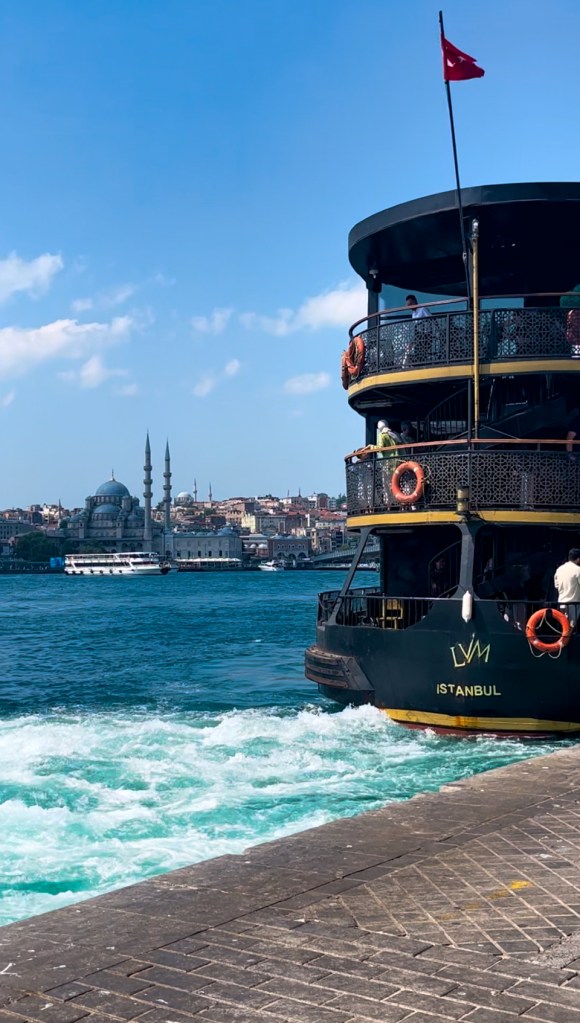
Along the water, fishermen were everywhere, often stopping to feed the stray cats that roamed the docks. Istanbul is practically the cat capital of the world—cats are everywhere and treated like royalty by the locals. We crossed back over the bridge to the European side, eager to try some local food. We stopped at a small hut right on the Bosphorus Strait that had a sign reading, “Best Büfe Since 1969.” If they say it, we had to trust it. We ordered döner kebab, a classic Turkish dish of seasoned meat (usually lamb, beef, or chicken) slowly roasted on a vertical rotisserie. The meat is shaved thin and stuffed into warm pita or flatbread with fresh veggies like lettuce, tomatoes, and onions, topped off with yogurt, garlic sauce, or hot sauce. It was exactly what we needed after a busy morning of exploration—juicy, flavorful, and delicious. To wash it down, we tried Ayran, a salty yogurt drink. It tasted like…well, salty milk, but strangely good in a way that made me want more. Definitely an acquired taste!
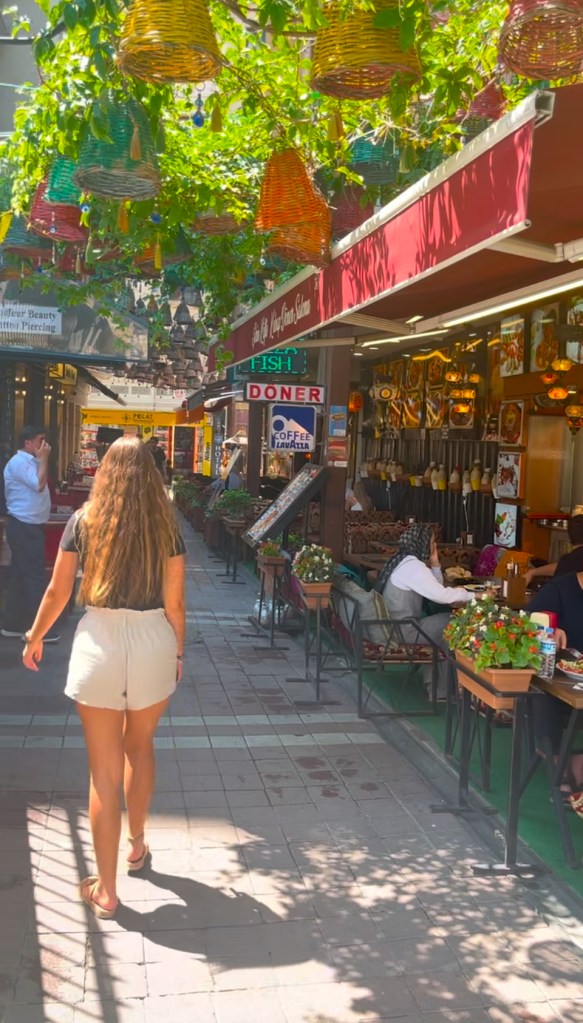
Next, we went to an underground strip mall called Aksaray Yeralti Carsisi. Which basically means the underground Bazaar, or market. This was the cheapest place to buy souvenirs. It gave the experience of one of those “I Love NY Gifts” stores in New York City that sell $0.99 statues of liberty.
There were a few stores selling fake Louis Vuitton bags and flashy, expensive-looking shoes like the ones popular in the U.S. However, I didn’t see many locals wearing anything flashy. The culture there seems more modest and practical when it comes to fashion.
One thing I noticed: No one wore T-shirts with big logos—unless they were obviously tourists. The men dressed sharp, the women too, no matter their class. Not necessarily expensive clothes, but well-put-together. Men wore slacks, plain shoes, and a decent shirt or jacket, even if they were just grabbing a coffee. It wasn’t about wealth, just an expectation of looking presentable. In the U.S., you’ll see millionaires in hoodies and joggers. Here, even the fishermen the looked like they had somewhere important to be.

The next stop on our adventure was within walking distance from the Bosphorus Bridge—the Istanbul Railway Museum. Honestly, we went in hoping for air conditioning. We were disappointed. But since we were already inside, we stuck around for the history. Surprisingly, the signs were in English, which made it easier to appreciate the small collection of artifacts. The terminal opened in 1890, and the museum had some old photos and equipment used back in the day. It’s free to enter and takes about 20-30 minutes to walk through—longer if you have a deep passion for antique train instruments. We, however, did not.
We decided to head back to the airport, so we called our tour guide, and he picked us up on the Bosphorus Bridge. As we drove through the countryside, the sudden contrast of Istanbul’s massive, ultra-modern airport felt surreal—like a spaceship dropped into the middle of a cowboy western. If you remember earlier, I mentioned the odd number of young, single American men on my flight from Miami. It wasn’t until we were in the security line that I finally realized why. About one in ten people was a bald man wearing a black headband, his scalp stained dark red from freshly implanted hair follicles. If you haven’t heard of “Turkish Hairlines,” you’re missing out. Istanbul isn’t just known for its world-class airport—it’s also the hair transplant capital of the world. The departure lounge was packed with men heading home, each sporting a brand-new hairline. The average cost of a hair transplant in Miami ranges from $10,000 to $20,000, while in Istanbul, the same procedure costs between $2,000 and $4,000, often including transportation, meals, and accommodation.
So there we sat in the Istanbul Airport, eating a gross Burger King chicken sandwich (which we had to take back twice and try to explain was made wrong) and sipping overpriced bottled water. We reflected on our 7:00 AM sprint through the airport that morning and couldn’t help but laugh. A single loose carpet tile in Miami had set off a chain of events that landed us here, sweaty and semi-delirious, in a city we hadn’t even planned to visit.
Our unplanned stopover meant we’d miss out on our pre-booked Pompeii tour in Italy. But, hey, sometimes things don’t go as planned, and occasionally, you end up in Istanbul with a long layover.
After the layover, we finally set our sights on Italy. The next challenge: catching the last train of the day to Sorrento. It was a race against time as we scrambled through the airport, panicking over which bus stop would take us to the train station. Once we finally arrived at the station, we got lost—rushing through terminals in a mad scramble and barely making it to the platform in time.
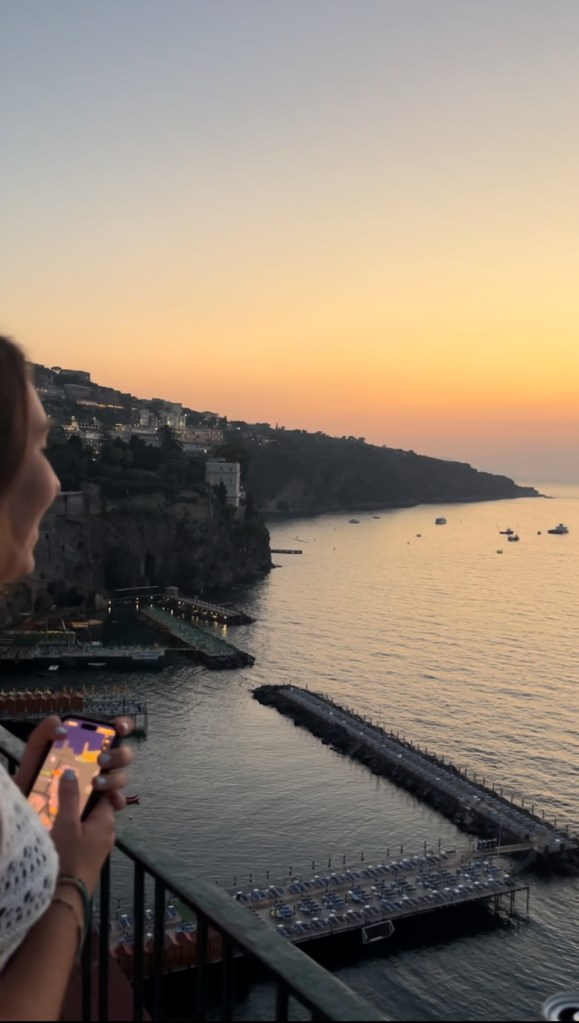
Then, just to keep the chaos rolling, my suitcase decided it had had enough. Two of its four wheels melted in the heat, forcing me to drag it a mile through the cobblestone streets of Sorrento—far from the grand arrival I’d imagined. But after all that, we made it to Sorrento—and it turned out to be the perfect home base for exploring the Amalfi Coast.
Click here to continue reading
 StartMedTravel
Leave a comment